Bookkeeping systems
DIY Bookkeeping: What It Really Costs When the Close Never Happens
DIY bookkeeping can work. The cost shows up when transactions are entered but accounts are not reconciled, balance-sheet problems are ignored, and no one finishes a reliable monthly close.
The question is not whether you can enter transactions. It is whether you can produce reconciled, review-ready financial statements every month without losing time needed to run the business.
Doing your own books is not automatically a mistake. Early-stage owners with a small transaction count, separate business accounts, and a consistent process may handle it well.
The trouble starts when the books become a collection of bank-feed clicks. A cleared queue can still hide duplicates, missing transactions, loan balances in expense accounts, unpaid liabilities, and an unreconciled balance sheet.

When DIY bookkeeping is reasonable
- The business has one entity and a small number of bank and credit-card accounts.
- Business and personal activity stay separate.
- Payroll, sales tax, loans, inventory, and owner transactions are limited or understood.
- Source documents are captured when transactions occur.
- Every balance-sheet account is reviewed and reconciled monthly.
- The owner can explain the numbers and produce records when asked.
The IRS does not require one particular bookkeeping program. It requires records that support income, expenses, property basis, returns, and financial statements. Electronic records must remain complete, accurate, and accessible.
Where DIY bookkeeping gets expensive
Owner time
Track the full time spent collecting documents, researching categories, correcting imports, reconciling, answering the tax preparer, and rebuilding forgotten months. Multiply those hours by the value of the work only the owner can do.
Repeated cleanup
Skipping the monthly close turns small questions into a reconstruction project. By year-end, descriptions are harder to remember and missing statements take longer to find.
Decisions made from unreliable reports
An unreconciled profit and loss can overstate cash, understate debt, or hide unpaid taxes. The cost is not only a filing problem. It is a pricing, hiring, borrowing, and cash-flow problem.
Tax-preparer rework
A tax preparer may need to stop and request corrected books when balance-sheet accounts do not tie out. That can mean extra fees, a rushed filing, or estimates that still require follow-up.
If you avoid opening the accounting file because you expect a mess, the system is already costing more than the subscription.
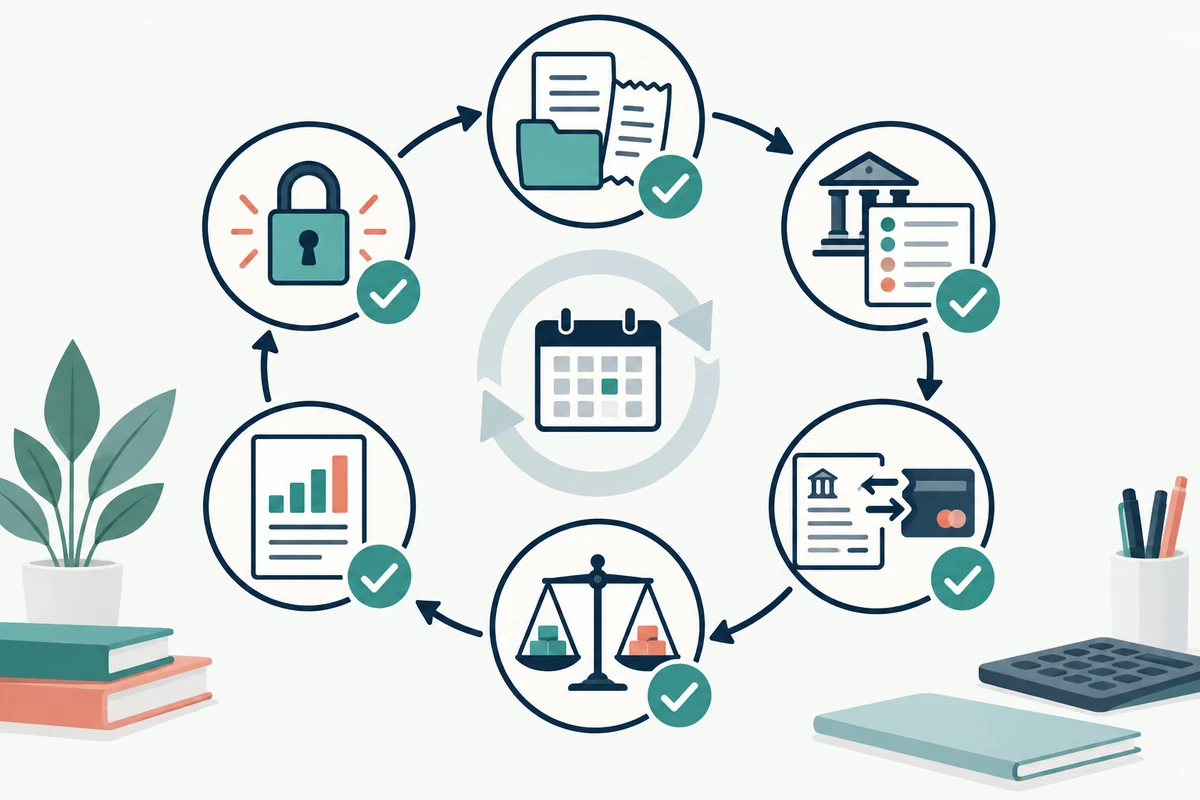
What a complete monthly close includes
- Collect bank, credit-card, loan, payroll, merchant, and other source records.
- Match existing transactions before adding new bank-feed entries.
- Review categorization, payees, classes, projects, and customer or vendor assignments.
- Reconcile every bank and credit-card account to an independent statement.
- Update loans, payroll liabilities, sales tax, fixed assets, owner activity, and clearing accounts.
- Review the balance sheet, profit and loss, receivables, payables, and unusual changes.
- Resolve or document open questions and lock the completed period.
Read the detailed guide to safer QuickBooks bank-feed rules and why automation still needs human review.
A practical keep-or-handoff test
| Keep DIY for now | Consider monthly help |
|---|---|
| You close by a consistent date. | Several months remain unreconciled. |
| Balance-sheet accounts have support. | Loans, payroll, sales tax, or clearing accounts drift. |
| Exceptions are few and documented. | You rely on broad auto-post rules or guesses. |
| Reports are used and understood. | You do not trust the profit and loss or balance sheet. |
| The time cost remains reasonable. | Bookkeeping repeatedly displaces sales or client work. |
A monthly bookkeeper should do more than categorize transactions. The work should include reconciliations, balance-sheet review, issue tracking, and a clear close cadence.
How to hand off without creating another mess
- Keep the original bank and credit-card statements.
- List every account, loan, payment processor, payroll system, and business card.
- Identify which periods are actually reconciled.
- Do not force a reconciliation difference to zero with an adjustment.
- Flag owner contributions, draws, reimbursements, and personal charges.
- Preserve prior tax returns and fixed-asset schedules.
- Write down unresolved questions instead of guessing.
If the books are already behind, review what catch-up bookkeeping should include.
QuickBooks Online
Useful when the account structure, bank-feed rules, reconciliations, and close process are set up deliberately.
Dext
Useful for capturing source documents before receipts and bills disappear into email and paper piles.
Frequently asked questions
Can a small-business owner do their own bookkeeping?
Yes. DIY can work with separate accounts, manageable complexity, reliable source documents, monthly reconciliations, and time for review.
Is clearing the QuickBooks bank feed the same as reconciling?
No. Reconciliation compares QuickBooks to an independent statement and resolves the difference for a defined period.
How often should small-business books be reconciled?
Monthly is the practical standard for most operating accounts. High-volume or high-risk accounts may need more frequent review.
When should I stop doing my own books?
Consider help when the close stays late, reports are unreliable, complexity increases, or the time cost consistently exceeds the benefit.
Does a $500 Bookkeeping Diagnostic clean up the books?
No. It identifies the problems and scopes the work. Catch-up or cleanup is a separate engagement.
Sources reviewed
Fact-checked September 9, 2026 against IRS guidance on why businesses keep records and recording business transactions, plus Intuit guidance for reconciling in QuickBooks Online and categorizing and matching bank transactions.
Find out what is actually wrong before paying for cleanup
The Diagnostic identifies reconciliation gaps, balance-sheet problems, and missing records, then scopes any separate catch-up or cleanup work. It does not perform the cleanup itself.

One Response