If your books have not been touched in months, you are not the only one. Bank feeds disconnect, statements go missing, and a file can look busy without ever being properly closed. Messy books are normal here, and they are fixable.
What problems usually show up in behind books?
Most catch-up files contain more than one problem:
- Bank-feed transactions with no review: Items were downloaded but never matched, categorized, or checked against the statement. Our guide to safe QuickBooks Online bank-feed rules explains why the feed cannot replace a monthly close.
- Mixed personal and business spending: Every transaction must be reviewed so owner activity does not distort business expenses.
- Duplicate entries: A transaction was entered manually and again through the bank feed, overstating income or expenses.
- Forced reconciliations: Someone added an adjustment instead of finding the difference. In QuickBooks Online, this may appear as a large, round, unexplained Reconciliation Discrepancies balance. Intuit says an adjusting entry should be a last resort for a small, confirmed error, not a shortcut for a material difference.
- Mystery balance-sheet accounts: Loans, payroll liabilities, undeposited funds, or equity balances do not agree with reliable records.
- Never reconciled at all: The file looks complete because transactions are coded, but no account has ever been matched to a statement. This is common in DIY files and files where someone only worked the bank-feed queue.
A clean-looking profit and loss report is not proof that the books are complete. Unfinished monthly closes often hide their biggest problems on the balance sheet.
What does the catch-up process include?
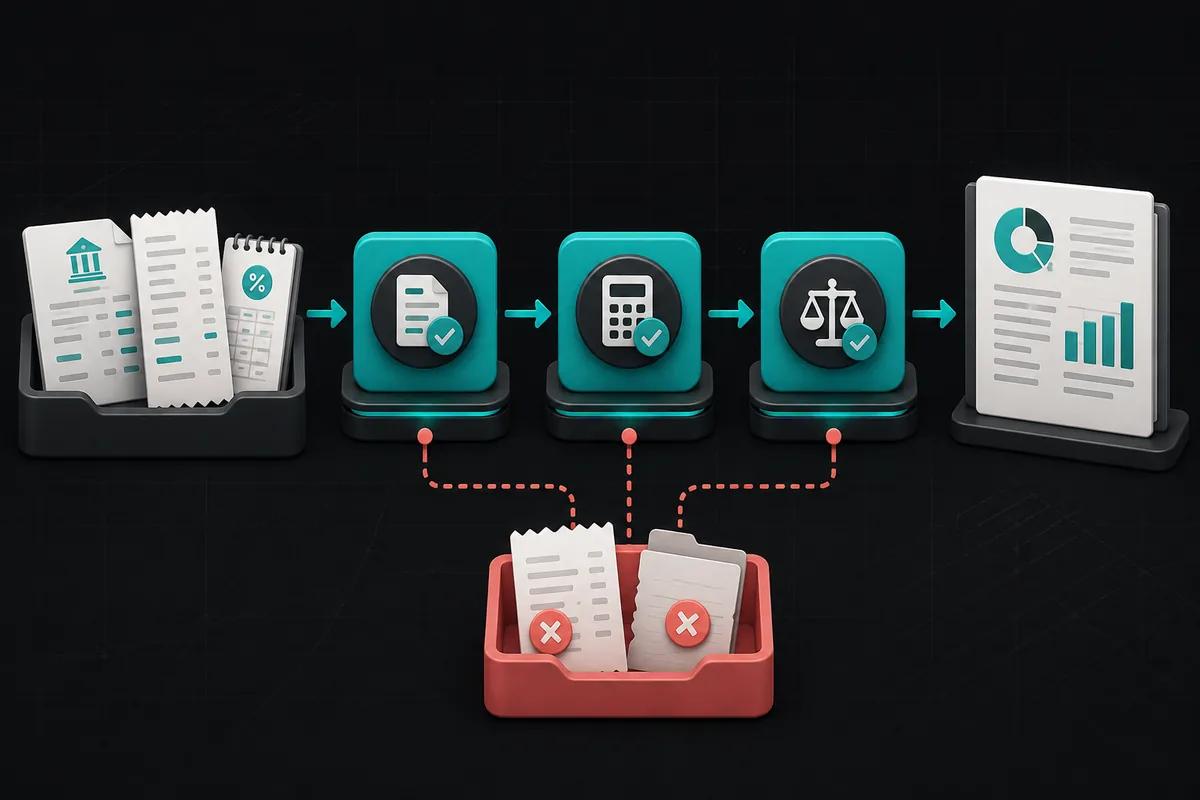
- Collect the source records. We identify every bank, credit card, payroll, loan, and merchant account used during the catch-up period.
- Review the existing file. We find the last reliable closing date, assess what can be kept, and identify duplicate, missing, or unsupported work.
- Record and correct transactions. Missing activity is added, coding is corrected, and transfers, owner activity, payroll, and loan payments are handled based on supporting records.
- Reconcile month by month. Each material cash and credit card account is matched to its statement. If it does not balance, we find the reason instead of force-balancing it. See Intuit’s current QuickBooks Online reconciliation guide.
- Support the balance sheet. Loans, payroll liabilities, fixed assets, clearing accounts, equity, accounts receivable, and accounts payable are reviewed when they apply.
- Finish with a documented review. We deliver usable reports and a written open-items list showing what was verified, reconstructed, or left unresolved.
How long does catch-up bookkeeping take?
The timeline depends on the number of months, accounts, transactions, entities, and missing records. A practical planning range is:
| Months Behind | Typical Timeframe |
|---|---|
| 1–3 months | 1–2 weeks |
| 4–6 months | 2–4 weeks |
| 7–12 months | 4–8 weeks |
| 1–2 years | 6–12 weeks |
| More than 2 years | Quoted after review |
These are planning estimates, not guaranteed completion dates. High transaction volume, payroll corrections, multiple entities, inventory, merchant processors, client response time, and missing statements can extend the work.
What does catch-up bookkeeping cost?
Catch-up bookkeeping is custom quoted after we review the records. The scope grows with the number of months and accounts, transaction volume, payroll, merchant processors, multiple entities, inventory, and the condition of the existing QuickBooks Online file.
A free 15–20 minute fit check is the simplest place to start. If the file needs a deeper written review before cleanup can be quoted, the optional Bookkeeping Diagnostic is $500 flat. It identifies the problems, documents what needs to be fixed, and gives us the information needed to quote the cleanup without guessing.
What if a filing deadline is coming?
Work backward from the filing date. If 12 months of catch-up may take 4–8 weeks, a calendar-year S corporation with a mid-March filing deadline should usually start in January, not in March. Capacity tightens during filing season, and missing records take time to recover.
The IRS generally requires a calendar-year S corporation to file Form 1120-S by the 15th day of the third month. Review the current Form 1120-S instructions and Form 7004 extension instructions with your tax preparer. Accurate books filed on extension are better than an on-time return built on guesses.
What if the records are actually gone?
Online statement availability varies by bank, account type, and enrollment history. Some major banks provide up to seven years online, while other products have shorter windows. Older statements can often be requested directly from the institution, and fees may apply. Closed-account records may require a direct request to the bank.
Where documentation cannot be recovered, we use the best available evidence, such as bank activity, matching invoices, payroll reports, loan records, merchant statements, and prior returns. We do not quietly force the file to balance. The gap goes on a written open-items list so your tax preparer knows which balances are fully supported and which were reconstructed.
For examples of how access periods vary, see the official statement guidance from Wells Fargo and Chase.
What do you receive when the work is finished?
A completed catch-up project should leave you with a QuickBooks Online file reconciled through an agreed date, a usable chart of accounts, supported material balance-sheet accounts, and financial statements your tax preparer can follow.
You also receive a written open-items list for anything that could not be verified, plus notes about recurring miscategorizations, owner activity, payroll issues, or process gaps that could recreate the problem. The deliverable is not just a cleaner report. It is a documented file with a clear stopping point.
Catch-up bookkeeping FAQs
Catch-up records missing periods, while cleanup corrects inaccurate work already in the file. Most behind books need both.
Catch-up bookkeeping is custom quoted after record review. Months behind, account count, volume, payroll, processors, entities, inventory, and missing records determine scope.
Sometimes, but missing evidence must be reconstructed and documented. Any unresolved gap belongs on a written open-items list for the tax preparer.
Material accounts should reconcile to reliable records, balance-sheet accounts should be supported, and unresolved items should be documented through an agreed closing date.
Sources reviewed: Intuit QuickBooks reconciliation guidance, IRS Instructions for Forms 1120-S and 7004, and current bank statement-access guidance. Fact-checked September 14, 2026.
QuickBooks Online is the accounting platform used for this work. View QuickBooks Online through our affiliate link.
Affiliate disclosure: Bugaboo Bookkeeping may earn a commission if you sign up through this link, at no additional cost to you. The relationship does not change our evaluation of the tool.
Behind on your books?
Start with a free 15–20 minute fit check. If you need a deeper written review, the optional Bookkeeping Diagnostic is $500 flat.