Crypto tax records
DeFi Taxes: Swaps, Liquidity Pools, Lending, and Yield
DeFi tax reporting follows what you gave up, what you received, and when you gained control of income. The protocol label alone does not decide the result.
A DeFi transaction can create income, a property disposition, both, or neither. Start with the legal and economic change in the assets, not the button name in the app.
The IRS treats cryptocurrency as property under Notice 2014-21. That gives us a starting point, but the IRS has not published a complete tax map for every automated-market-maker, lending vault, bridge, wrapper, or rebasing token.
That is why confident blanket statements are risky. A good DeFi workpaper records each step and separates settled guidance from a position that needs tax-professional review.

A practical DeFi tax map
| Activity | Possible tax question | Evidence to retain |
|---|---|---|
| Token swap | Did you dispose of one property asset for another? | Units sent and received, USD values, fee, time, transaction hash. |
| Wrap or unwrap | Did your property rights materially change? | Protocol terms, redemption rights, one-to-one relationship, wallet history. |
| Liquidity deposit | Were contributed tokens exchanged for an LP interest? | Assets contributed, LP token received, pool share, values, fees. |
| Staking or yield reward | When did you have dominion and control over new units? | Quantity, timestamp, availability, USD value, later disposition. |
| Loan | Was beneficial ownership retained, and what did the receipt token represent? | Agreement, collateral, interest, liquidations, receipt tokens, repayments. |
Swaps, bridges, and wrapped assets
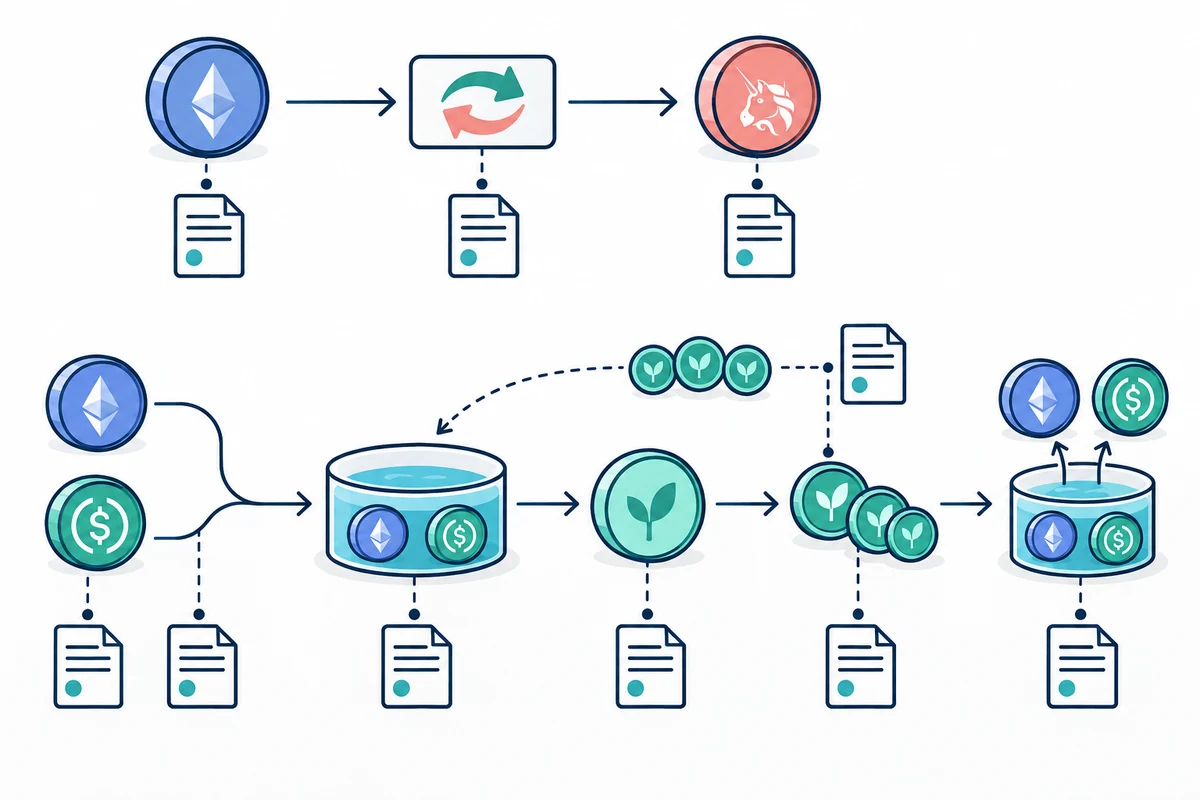
Exchanging token A for token B is generally treated like a property-for-property exchange. The disposed token produces gain or loss based on amount realized less adjusted basis, while the received token starts with a new acquisition record.
A bridge or wrapper deserves a closer look. Some arrangements may preserve substantially the same asset and rights; others issue a different token or move through a transaction structure that changes ownership. Record the facts instead of assuming every wrap is taxable or every wrap is tax-free.
IRS Notice 2024-57 temporarily excepts brokers from Form 1099-DA reporting for certain DeFi activities, including some wrapping, liquidity-provider, staking, and lending transactions, until further guidance. That exception does not declare those transactions tax-free.
Liquidity pools and LP tokens
When you contribute assets to a pool and receive an LP token, analyze whether you exchanged the original assets for a separate property interest. The answer can depend on the protocol’s terms and the rights represented by the LP token.
On withdrawal, compare what leaves the position with what comes back. Pool rebalancing, accumulated fees, impermanent loss, and incentive tokens should not be collapsed into one unexplained gain or loss.
Staking, lending interest, and yield rewards
Staking rewards are taxable as ordinary income when you have dominion and control over the rewarded units under Rev. Rul. 2023-14. The USD value included in income generally becomes basis for a later sale.
Lending interest, liquidity incentives, governance tokens, and yield-farming rewards may also create income when received or made available, depending on the facts. Do not count the same value twice when a dashboard accrues an estimate and the wallet later receives the actual units.
Read the related guide on staking reward income and basis.
The records a DeFi ledger needs
- Every wallet address and which person or entity controlled it.
- Transaction hashes, block times, token contract addresses, and chain.
- Units sent and received, including LP and receipt tokens.
- A consistent USD valuation source at each taxable timestamp.
- Gas and protocol fees, including the asset used to pay them.
- Protocol terms or screenshots that explain redemption and ownership rights.
- Links between self-transfers so basis and holding period are not lost.
- The tax position used when guidance is unsettled.
Start by removing known self-transfers. Then classify acquisitions, disposals, income, fees, and genuine exceptions. A public transaction proves movement, but it does not prove wallet ownership, tax basis, or business purpose.
Koinly
Useful for importing multi-chain activity before testing protocol classifications and transfers.
Arkham
Useful for investigating public-chain transaction paths. It does not establish ownership or basis by itself.
Related Bugaboo guides
- FIFO, HIFO, and specific identification
- How to calculate crypto capital gains
- Crypto tax reconciliation services
Frequently asked questions
Is every DeFi transaction taxable?
No. Tax treatment depends on the assets, rights, and income involved. Self-transfers are generally not sales, while swaps and rewards often create reportable events.
Is swapping one token for another taxable?
Generally, yes. Exchanging one digital asset for another is usually a disposition of the asset surrendered.
Are liquidity-pool deposits taxable?
They may be. Analyze whether contributed assets were exchanged for a separate LP interest and document the position rather than applying a blanket rule.
Are DeFi rewards taxable before I sell them?
Often, yes. Newly received rewards can create ordinary income when you gain dominion and control, followed by gain or loss when you later dispose of them.
Does the Form 1099-DA exception make DeFi tax-free?
No. Notice 2024-57 addresses broker reporting for identified transactions. It does not remove the taxpayer’s underlying reporting obligation.
Sources reviewed
Fact-checked September 9, 2026 against the IRS digital-assets hub, Notice 2014-21, Notice 2024-57, and Rev. Rul. 2023-14.
Turn the wallet history into a scoped cleanup plan
The Diagnostic identifies missing history, unsupported transfers, and protocol-classification issues, then scopes any separate reconstruction work. It does not perform the cleanup itself.