Small-business controls
Should a Small Business Hold Crypto? Accounting, Tax, and Controls
A business can hold or accept cryptocurrency, but the decision needs a documented purpose, clear entity ownership, secure custody, enough cash for operations, and a ledger that records every taxable event.
Do not buy crypto through the company just because it sounds like diversification. Decide what business problem it solves, how much loss the company can absorb, and who is authorized to move the assets.
Holding an investment is different from accepting crypto from customers. Paying a vendor is different from transmitting funds for other people. Those activities can create different tax, accounting, security, and regulatory questions.
This guide is about operational readiness, not a recommendation to buy or sell any asset.

Five questions before company money buys crypto
- Purpose: Is this a treasury investment, a customer-payment channel, or an operating asset?
- Liquidity: Can payroll, tax, debt, and vendor obligations be paid without selling during a market drop?
- Authority: Who approves purchases, transfers, staking, collateral, and sales?
- Custody: Who controls keys, recovery material, and exchange access if an employee leaves?
- Records: Can the company support USD value, basis, income, fees, and each wallet transfer?
If any answer is unclear, pause before funding the account. A board or owner resolution should document the authorized activity, limits, approved platforms, signers, and reporting cadence.
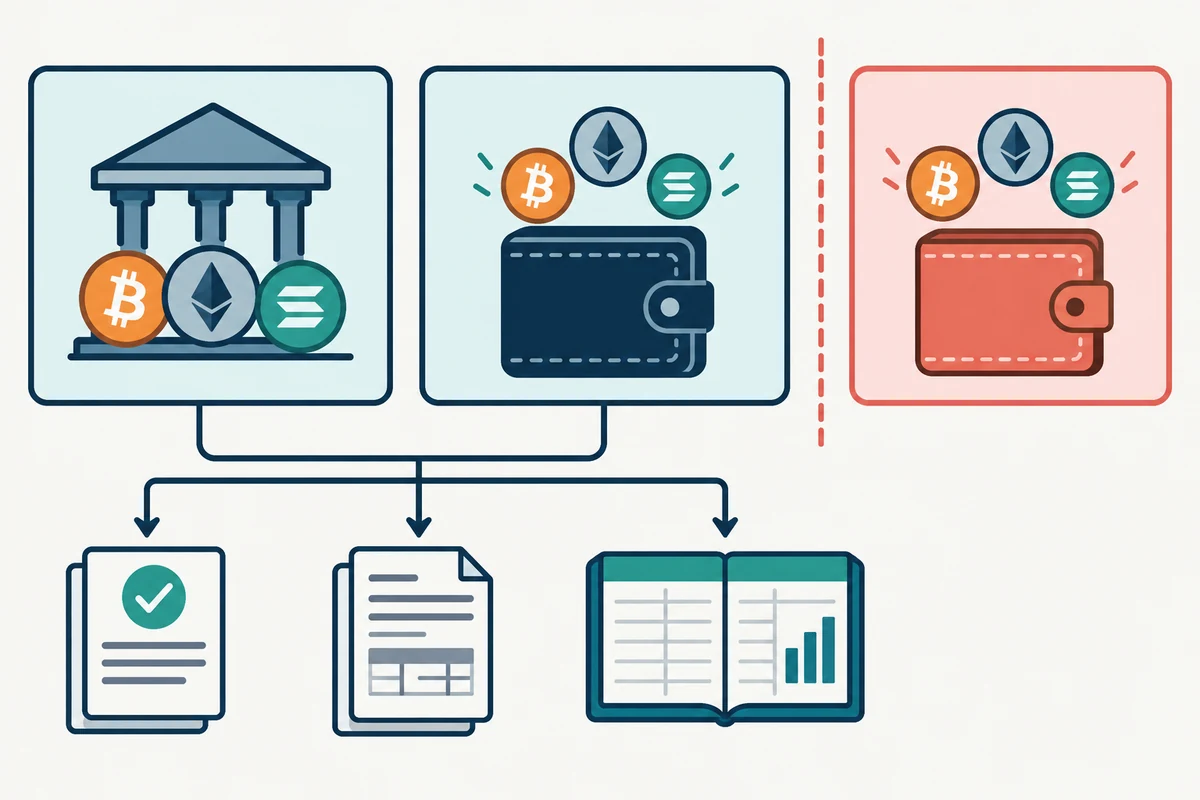
Keep company crypto separate from the owner
Open exchange accounts in the company’s legal name and complete onboarding with the company’s tax information. Use company-controlled wallets, not an owner’s long-standing personal wallet.
If an owner contributes crypto, document the contributor, transaction hash, date, quantity, fair value, tax basis information provided, and the legal character of the contribution. Blockchain movement by itself does not prove ownership or basis.
Book accounting and tax records are not the same ledger
For federal tax, the IRS treats digital assets as property. A sale or exchange can create gain or loss, while crypto received for goods or services is generally income measured in U.S. dollars when received.
For GAAP financial statements, FASB ASU 2023-08 requires qualifying in-scope crypto assets to be measured at fair value each reporting period, with changes recognized in net income. The scope has specific criteria and does not cover every token or arrangement.
Fair-value financial reporting does not replace the tax-lot ledger. Keep quantity by asset, book carrying value, tax basis by lot, realized activity, unrealized book changes, and custody location separately identifiable.
| Record | What it answers |
|---|---|
| General ledger | What belongs in the financial statements? |
| Tax-lot ledger | What basis and holding period belong to each disposed unit? |
| Wallet subledger | How many units should exist in each company-controlled location? |
| Approval log | Who authorized each purchase, transfer, or sale? |
Accepting crypto and paying with crypto
When a customer pays in crypto, record revenue at the asset’s fair market value in U.S. dollars when received. That value generally becomes the asset’s starting tax basis. A later sale or exchange is a separate event.
Paying employees with crypto does not avoid payroll rules. Notice 2014-21 says the fair market value of virtual currency paid as wages is subject to withholding, FICA, FUTA, and Form W-2 reporting.
Business payments to independent contractors or other recipients may also require information reporting and backup withholding under the same rules that apply to property payments. Confirm the current form and threshold for the payment year.
Using crypto for the company’s own purchases does not, by itself, make the company a money transmitter under FinCEN’s user guidance. Accepting and transmitting value for other people can require a different analysis.
Minimum custody and close controls
- Two-person approval for material transfers.
- Hardware-backed authentication and separate recovery procedures.
- No seed phrases, private keys, or recovery codes in the accounting file.
- An approved wallet and exchange inventory.
- Daily capture of transaction hashes and source documents.
- Monthly reconciliation of units by asset and wallet.
- Independent price support at reporting dates and taxable events.
- A tested exit plan if an exchange freezes withdrawals or a signer becomes unavailable.
Reconcile quantity before value. A perfect price attached to the wrong number of units is still wrong.
QuickBooks Online
Useful for the company general ledger, approvals, monthly close, and financial reporting.
Review QuickBooksKoinly
Useful for consolidating company wallet and exchange activity into a separate tax-lot workstream.
Review KoinlyRelated Bugaboo guides
- How to calculate crypto capital gains
- DeFi transaction records and tax issues
- Bookkeeping for clean operational records
- Crypto reconciliation services
Frequently asked questions
Can an LLC buy cryptocurrency?
Yes, but authority, ownership, custody, accounting, and tax treatment should be documented before company funds are used.
Can I use my personal wallet for company crypto?
Avoid it. Separate company-controlled accounts and wallets make ownership, approvals, basis, and financial reporting easier to support.
How does a business record crypto received from a customer?
Record revenue in U.S. dollars at fair market value when received, then create a basis record for the digital asset held.
Can a business pay employees in cryptocurrency?
Yes, but the fair market value remains wages subject to federal withholding, payroll taxes, and Form W-2 reporting.
Does GAAP fair-value accounting replace tax-basis tracking?
No. Financial-statement measurement and tax-lot basis answer different questions and should be maintained separately.
Sources reviewed
Fact-checked September 9, 2026 against IRS Notice 2014-21 and the digital-assets hub, FASB ASU 2023-08, and FinCEN guidance for users, exchangers, and administrators.
Separate the company books from the crypto subledger
We can identify which records exist, where ownership or basis is unclear, and whether a $500 Diagnostic is the right next step.
Request a fit check